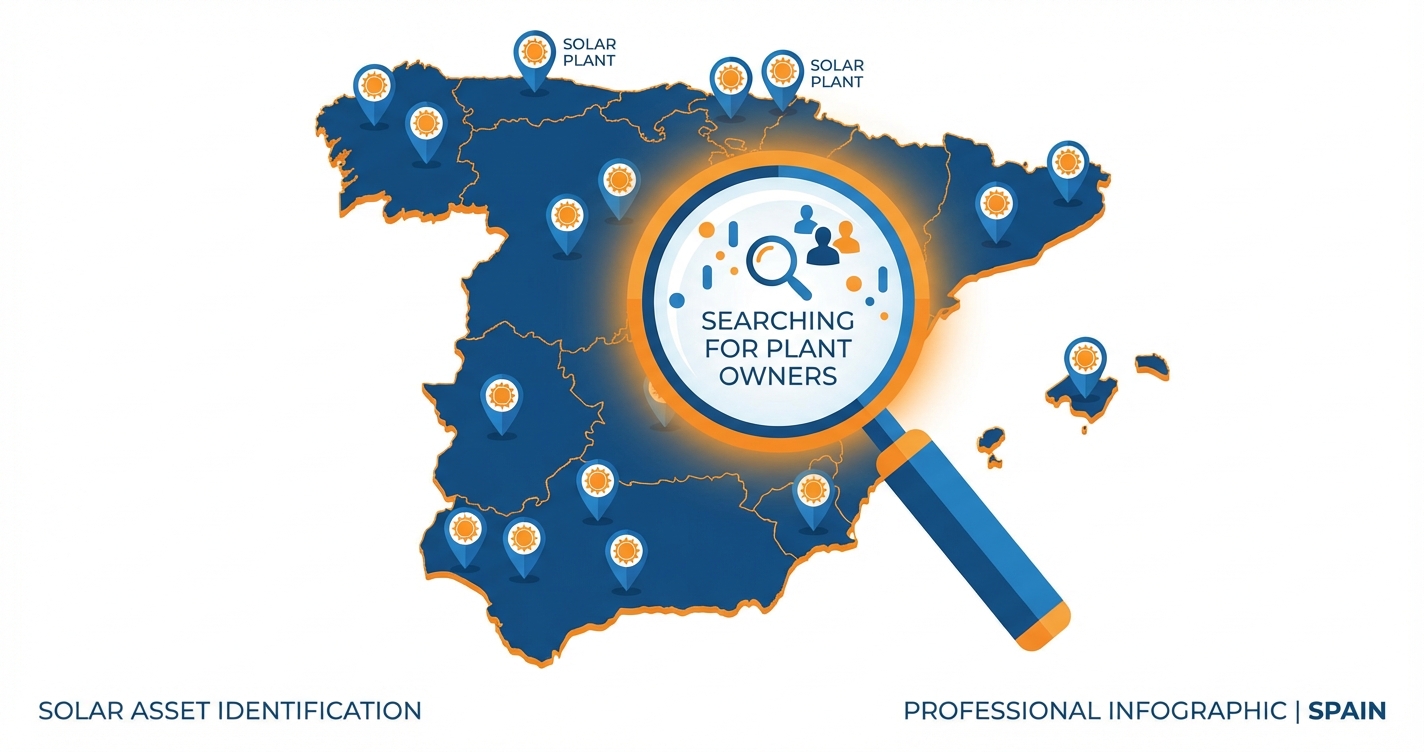
How to Find the Owner of a Solar Plant in Spain
Knowing who owns a solar plant in Spain is one of the most valuable pieces of information in the photovoltaic sector. Whether you are an O&M company looking to grow your portfolio, a market representation firm seeking new clients, or an investor performing due diligence, identifying the owner behind a plant is the first step to doing business.
The challenge? Solar plant ownership data in Spain is scattered across multiple official registries, administrative files and public databases — none of which were designed to be used together. This guide gives you a practical, step-by-step method to find the owner of any photovoltaic plant in Spain, and shows you how platforms like PV Maps collapse that research time from weeks to seconds.
Why Knowing the Owner Matters
Before diving into the methods, it is worth framing why this information is so commercially powerful.
- O&M companies need to approach the right decision-maker with a tailored offer, not a generic email blast. Knowing the asset owner — not just the operator — means you go directly to the door of the person who signs the contract.
- Market representation firms need to understand who controls the plant’s energy dispatch strategy. The owner determines the representation contract, not the grid operator.
- Investors conducting acquisition screening need to verify current ownership structures, any encumbrances and the corporate entity behind an asset before entering negotiations.
In all three cases, a wrong lead wastes months. Accurate ownership data is a competitive edge.
Method 1: The PRETOR Registry
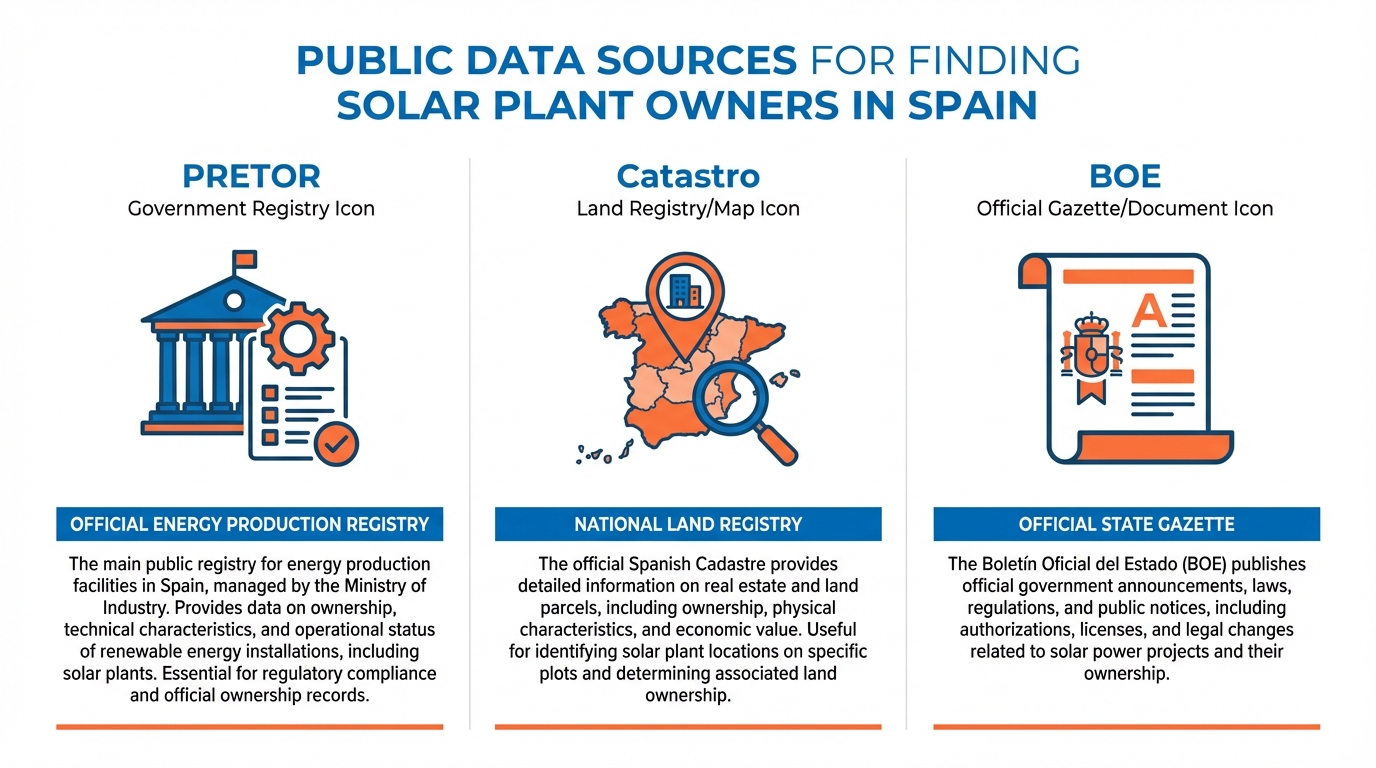
PRETOR (Registro de Productores de Energía Eléctrica) is the official registry managed by the Spanish Ministry for Ecological Transition (MITECO). It is the single most authoritative source for installed photovoltaic capacity in Spain.
What PRETOR Contains
Every plant connected to the Spanish grid must register in PRETOR. The registry includes:
- Plant name and unique identifier (CIL)
- Technology type and installed power (MWp)
- Grid connection point
- The legal entity (NIF/CIF) of the producer
The producer listed in PRETOR is the legal owner of the generation activity — this is the company or individual that signs Power Purchase Agreements (PPAs) and receives market revenue.
How to Search PRETOR
PRETOR data can be consulted via MITECO’s official portal. You can filter by technology, province and power range. For photovoltaic plants above 1 MW you will typically find a registered company name. The limitation is that PRETOR does not give you the full corporate tree — you will see a subsidiary, not necessarily the ultimate parent fund or investment group.
Tip: Take the NIF/CIF from PRETOR and cross-reference it with the Registro Mercantil (Spain’s commercial register) to identify the parent company and its shareholders.
Method 2: The Spanish Cadastre (Catastro)
The Catastro is Spain’s land registry. Every parcel of land in Spain has a cadastral reference, and the Cadastre records the current owner of each parcel.
Finding a Plant via the Cadastre
- Go to the Sede Electrónica del Catastro at sedecatastro.gob.es.
- Use the map viewer to navigate to the location of the plant you are researching.
- Click on the land parcel (the polygons you see on satellite view) to retrieve the cadastral reference and the registered owner.
For photovoltaic plants, the ownership shown in the Cadastre is typically a special-purpose vehicle (SPV) — a project company created specifically for that plant. The SPV name will often include “Solar”, “PV”, “Energía” or the plant name itself.
Limitations of the Cadastre Approach
- Large plants span dozens of parcels. You may need to check multiple polygons to find the one registered to the energy company rather than a farming cooperative.
- The Cadastre updates on a 1-2 year lag, so very recently acquired or constructed plants may still show the previous landowner.
- The SPV name alone rarely tells you who the ultimate beneficial owner is.
Method 3: BOE (Official State Gazette) and Administrative Files
When a photovoltaic plant above 50 kW is authorized in Spain, the authorization process generates a paper trail in the BOE (Boletín Oficial del Estado) and in the regional Official Gazettes (BOJA, BOCYL, DOE, etc.).
What to Search For
Searching for a plant name or a municipality in the BOE archive will often surface:
- The original developer’s name from the initial authorization
- Any subsequent change of ownership that required administrative approval
- Grid access permits and connection agreements
This method is particularly useful for plants built before 2015, as older installations generated more public administrative documentation. For newer plants, much of the process has moved to regional competencies and is harder to consolidate.
Method 4: PV Maps — The Fast Route
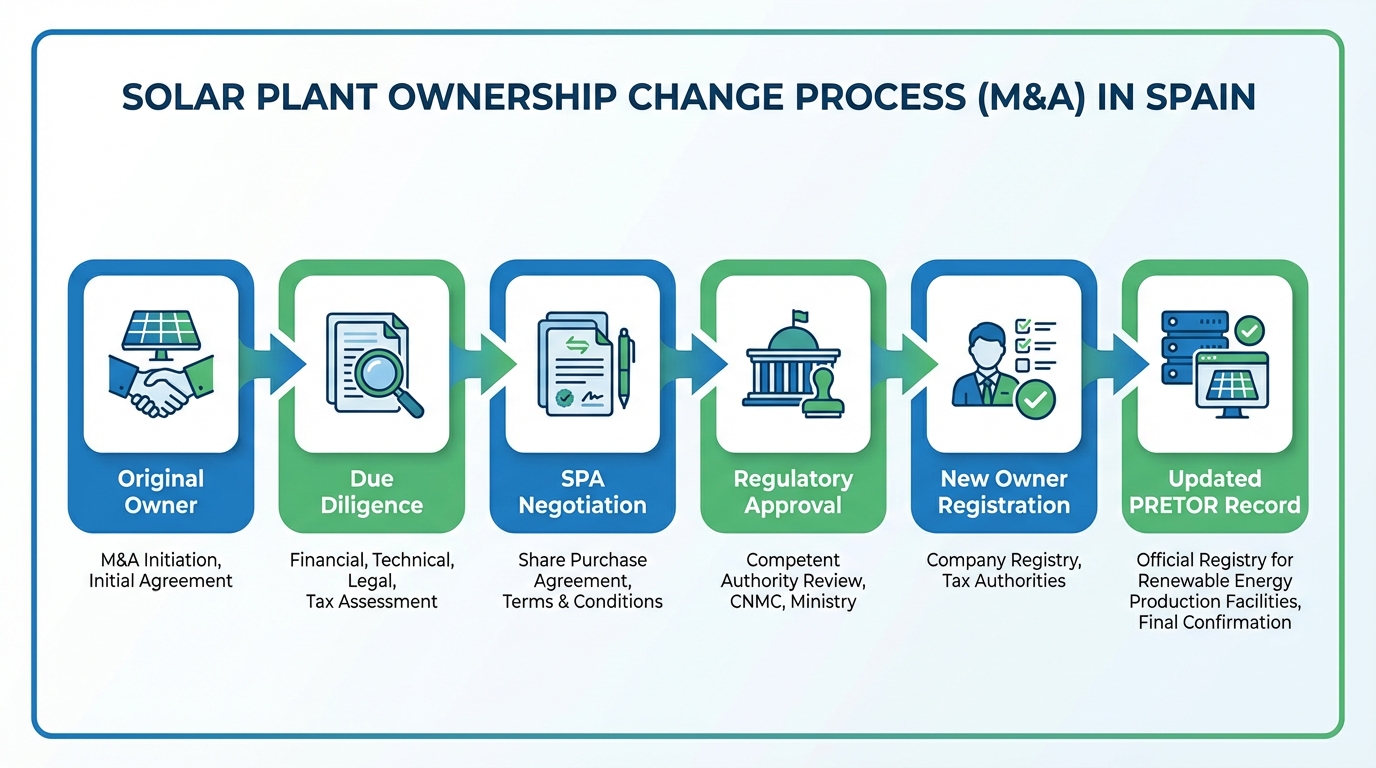
The methods above work, but they are manual, time-consuming and require expertise in navigating Spanish administrative systems. Each plant can take 2-4 hours of research across multiple portals. At scale — if you are prospecting 50 or 500 plants — that is simply not viable.
PV Maps aggregates ownership, technical and operational data for photovoltaic plants across Spain into a single interactive platform.
What You Get in PV Maps
From the plant inventory, for each plant you can access:
- Registered owner / titular: The legal entity behind the plant, not just the operator
- Installed capacity (MWp) and technology type
- Commission date: When the plant entered commercial operation
- Location: Exact coordinates on an interactive map
- Real energy generation data: Actual MWh produced and market revenue from OMIE
Instead of cross-referencing PRETOR, the Cadastre and the BOE manually, you access all of this in a unified interface — filterable by province, power range, technology and ownership.
Use Cases for O&M Companies
If you offer O&M services and want to identify plants whose current O&M contract may be expiring, you can filter by commission date. Plants commissioned 5-7 years ago are statistically the most likely to be reviewing their maintenance contracts. You then have the owner’s legal entity name, which you can use to find the right contact through LinkedIn or the Registro Mercantil.
Use Cases for Market Representation
If you represent solar plants in energy markets, PV Maps gives you the ownership data plus the actual market performance of each plant — normalized production, price capture rates and income per MWh. This means you can approach an owner with a specific, data-backed pitch: “Your plant in Badajoz captured €X/MWh last year. Our portfolio average is €Y/MWh. Here is how we would improve that.”
Combining the Methods: A Practical Workflow
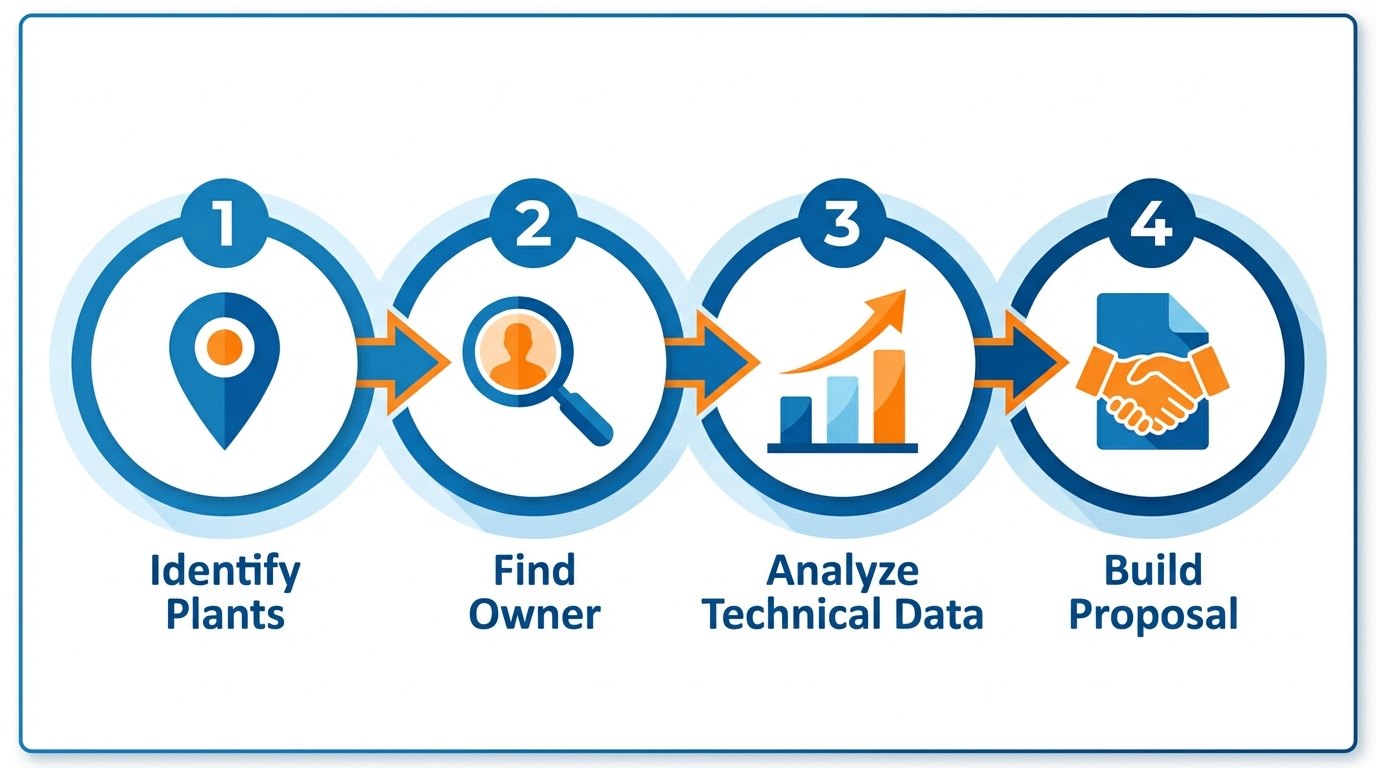
The most effective approach combines all sources in a structured workflow:
- Start with PV Maps to get the registered owner and basic plant data in seconds.
- Verify in PRETOR if you need the official CIL identifier for regulatory purposes.
- Check the Cadastre if you need to confirm land ownership (relevant for lease negotiations or due diligence).
- Search the BOE if you need the full administrative history — relevant for investors or legal teams.
This workflow typically reduces ownership research time from 2-4 hours per plant to under 15 minutes.
Frequently Asked Questions
Is it legal to look up solar plant owners in Spain?
Yes. All the sources described in this guide — PRETOR, the Cadastre, the BOE — are public registries mandated by Spanish law. There is no legal barrier to consulting them for commercial or research purposes.
Can I find the ultimate beneficial owner, not just the SPV?
PRETOR and the Cadastre typically show the SPV. To trace the ultimate beneficial owner, you need to cross-reference the Registro Mercantil and, for foreign-owned assets, international corporate registries. PV Maps increasingly links SPVs to their parent groups where this information is publicly available.
How often is the ownership data updated?
PRETOR updates regularly, though not in real time. Cadastre data has a 1-2 year lag. PV Maps updates its ownership database continuously as new public information becomes available.
Start Finding Solar Plant Owners Today
The Spanish photovoltaic market has over 6,000 utility-scale plants, each with an owner who could be your next client. The companies winning new business in O&M and market representation are the ones with the best prospecting data — not the best cold-calling scripts.
Explore the PV Maps plant inventory to access ownership, technical and operational data for solar plants across Spain.
View the interactive map to find plants by location and filter by ownership, capacity and commission date.
Or view all data to see how the platform can support your commercial prospecting workflow.