Subsidies and Aid for Photovoltaic Plants in Spain 2026: Complete Guide
Introduction
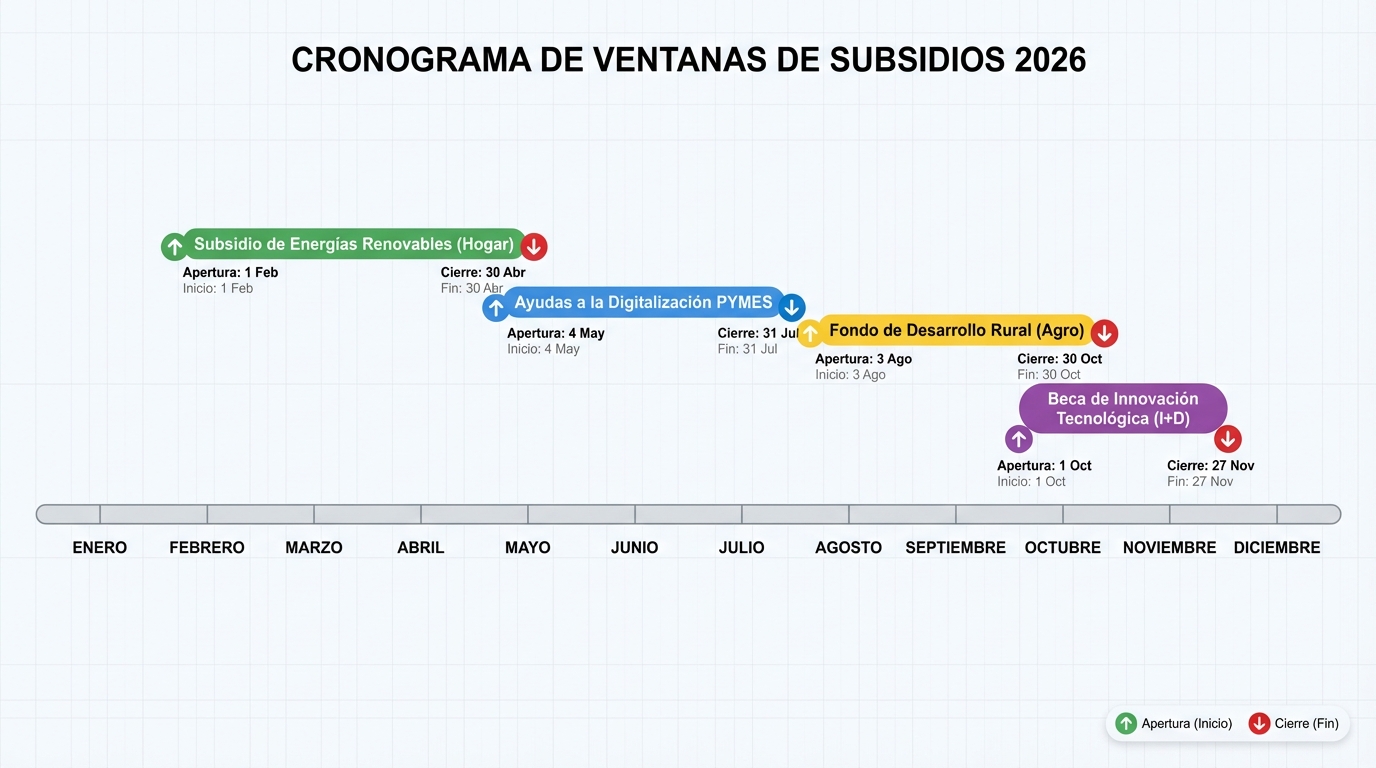
The development of photovoltaic plants in Spain has received a significant boost thanks to multiple public aid programs from state funds (IDAE), regional, and European (Next Generation EU). In 2026, although the sector has matured and costs have fallen considerably, there are still funding programs that can reduce your CAPEX by 15% to 40%, dramatically improving your project’s IRR.
However, navigating the subsidy ecosystem is complex: each program has specific eligibility requirements, strict deadlines, and administrative procedures that can take 12-18 months from application to payment. Additionally, many funds have already been committed in previous rounds, so it’s critical to know which programs are still active and which have closed.
In this article, we provide an updated catalog of all aid programs available in 2026, break down eligibility requirements, explain the application process step by step, and analyze the real financial impact on a typical plant’s business model.
1. Overview of aid in 2026
Status of Next Generation EU funds
European recovery funds (Next Generation EU) were the main source of aid between 2021-2025. In 2026, most of these programs have ended or are in closing phase, but some components remain active:
| Program | 2026 Status | Remaining Budget |
|---|---|---|
| PERTE ERHA (Renewable Energy) | ⚠️ Final phase | ~€200M (competitive allocation) |
| MOVES III Singular | ❌ Closed | €0 |
| ICO Next Generation Lines | ✅ Active | Loans (not direct subsidy) |
| FEDER Funds 2021-2027 | ✅ Active | Variable by region |
New 2026 programs
The Government has launched new specific programs for:
- Repowering of old plants (> 10 years)
- Hybridization (adding BESS to existing plants)
- Pilot projects (innovative technologies: agrivoltaic, floating)
2. IDAE Program: Aid for singular projects
Description
The Institute for Energy Diversification and Saving (IDAE) manages aid programs for renewable energy projects that meet singularity criteria (innovative technology, relevant size, socioeconomic impact).
Eligibility requirements
| Criterion | Description |
|---|---|
| Minimum power | 5 MWp (photovoltaic) |
| Innovation | Use of non-standard technology (bifacial, 2-axis trackers, floating, agrivoltaic) |
| Location | Just transition zones (former mining basins) have priority |
| Social impact | Local job creation (minimum 5 direct positions) |
| Financing | Maximum 50% of eligible CAPEX |
Amounts
- Subsidy: 20-40% of eligible CAPEX
- Soft loan: Up to additional 50% (0.5% interest, 15 years)
- Combined maximum: 70% of CAPEX
Application process
Phase 1: Pre-application (2 months)
- IDAE platform registration
- Technical report submission (50-80 pages):
- Project description
- Technological innovation
- Environmental analysis
- Business plan
- Socioeconomic impact statement
Phase 2: Evaluation (3-6 months)
- Technical committee evaluates projects
- Ranking by score (criteria: innovation 40%, impact 30%, viability 30%)
- Provisional award
Phase 3: Formalization (2-4 months)
- Agreement signing
- Presentation of guarantees (bank guarantee or surety bond)
- Project execution start
Phase 4: Justification (1-2 years)
- Execution milestones (quarterly)
- Technical audit upon work completion
- Subsidy payment (50% upon completion, 50% after 12 months of operation)
⚠️ Limitations
- Very long deadlines: From application to final payment can take 2-3 years
- Strict justification requirements: Any budget deviation > 10% requires approval
- Denial risk: Approval rate ~30-40% (very competitive)
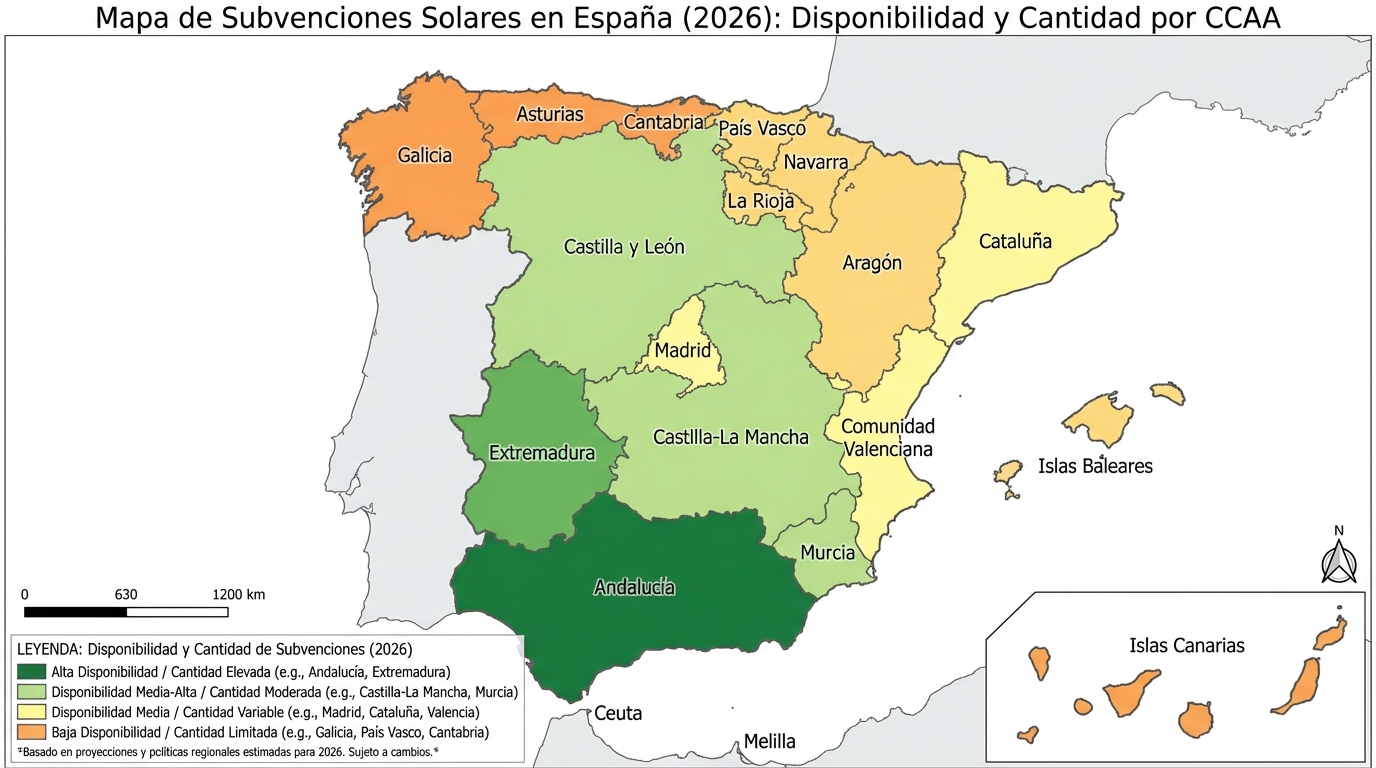
3. Regional aid by autonomous community
Andalusia
Program: Incentives for Sustainable Energy Development
- 2026 Budget: €120M
- Eligibility: Plants > 1 MW in municipalities < 20,000 inhabitants
- Subsidy: 15-25% CAPEX
- Deadline: Open until 06/30/2026
Contact: Agencia Andaluza de la Energía
Extremadura
Program: Renova Extremadura Plan
- 2026 Budget: €45M
- Eligibility: Repowering of old plants (> 10 years)
- Subsidy: Up to 30% of repowering CAPEX
- Deadline: Open all 2026 (until funds exhausted)
Contact: Consejería de Transición Ecológica
Castilla-La Mancha
Program: CLM Renewable Energy Aid
- 2026 Budget: €80M
- Eligibility: Projects > 3 MW with valid access and connection certificate
- Subsidy: 18% CAPEX + 5% bonus if includes storage
- Deadline: Semi-annual call (next: February 2026)
Contact: Instituto de Promoción Económica CLM
Aragón
Program: Aragonese Energy Transition Fund
- 2026 Budget: €35M
- Eligibility: Innovative projects (agrivoltaic, livestock integration)
- Subsidy: Up to 40% if includes R&D component
- Deadline: Open until 09/30/2026
Contact: Instituto Aragonés de Fomento
Galicia
Program: Galicia Renewable Impulse Plan
- 2026 Budget: €25M
- Eligibility: Plants < 10 MW (focus on medium projects)
- Subsidy: 20% CAPEX
- Deadline: Closed (last call in 2025)
Status: ⚠️ Verify opening of new call in 2027
Summary table
| Region | Budget | Key Eligibility | Subsidy | Status |
|---|---|---|---|---|
| Andalusia | €120M | > 1 MW, small municipalities | 15-25% | ✅ Open |
| Extremadura | €45M | Repowering > 10 years | Up to 30% | ✅ Open |
| Castilla-La Mancha | €80M | > 3 MW with access | 18-23% | ✅ Open |
| Aragón | €35M | Innovative (agrivoltaic) | Up to 40% | ✅ Open |
| Galicia | €25M | < 10 MW | 20% | ❌ Closed |
4. ICO financing lines
ICO Business and Entrepreneurs (Next Generation Line)
Description: Long-term loans with partial state guarantee
- Amount: Up to €12.5M per project
- Interest: Euribor + 0.5% - 1.5% (depending on company size)
- Term: Up to 20 years (includes 2-year grace period)
- ICO Guarantee: 50% of loan (reduces required guarantees)
Eligibility:
- SMEs and large companies
- Projects with access and connection permits
- Minimum investment: €1M
Advantage vs private bank financing: Interest 1-2 percentage points lower
Comparative example
10 MWp plant, €5.5M CAPEX, 70% financing (€3.85M)
| Option | Interest | Annual Payment (15 years) | Total Interest Cost |
|---|---|---|---|
| Private bank | 5.5% | €380,000 | €2.15M |
| ICO Line | 4.0% | €344,000 | €1.31M |
| ICO Savings | - | €36,000/year | €840,000 |
Impact on IRR: +1.2 percentage points
5. FEDER European funds (2021-2027)
Description
European Regional Development Funds (FEDER) finance regional development projects, including renewable infrastructure.
Management
- National: Ministry of Ecological Transition
- Regional: Each autonomous community manages its own allocation
Prioritization criteria
| Criterion | Weight |
|---|---|
| Location in low population density areas | 30% |
| Local employment impact | 25% |
| Technological innovation | 20% |
| Social participation (cooperatives, energy communities) | 15% |
| Emission reduction | 10% |
Amounts
- Subsidy: 30-50% of eligible CAPEX (higher in less developed regions)
- Maximum per project: Variable (typically €5-10M)
Process
- Annual call (each region publishes its calendar)
- Online application with technical report
- Evaluation (6-12 months)
- Payment in milestones (25% start / 50% completion / 25% after 1 year operating)
⚠️ Important: FEDER funds are not compatible with IDAE aid on the same eligible expenses (avoids double financing).
6. Specific aid: Repowering, hybridization and innovative technologies
A. Repowering Program 2026
Objective: Modernize plants installed between 2008-2015 (obsolete technology)
Eligibility:
- Plants with > 10 years of age
- Replacement of panels with efficiency < 18% by > 22%
- Power increase allowed (according to access permit)
Subsidy: 25% of repowering CAPEX
Total budget: €150M (national)
Deadline: Open until 12/31/2026
Example case:
- Original plant: 5 MW (250 Wp polycrystalline panels, 2012)
- Repowering: 7.5 MW (550 Wp monocrystalline panels)
- Cost: €2.8M
- Subsidy: €700,000
- Repowering payback: 5.2 years
B. Hybridization Program (PV + BESS)
Objective: Add storage to existing plants to reduce curtailment and optimize sales
Eligibility:
- Operational plants with > 2 years of history
- Areas with documented curtailment (> 3% annual energy)
- Minimum BESS: 1 MWh
Subsidy:
- 30% of BESS CAPEX
- Additional 10% bonus if includes AI optimization software
Total budget: €100M (national)
Deadline: Open until 06/30/2026
C. Innovative Pilot Projects
Eligible technologies:
- Agrivoltaic: Integration with crops or livestock
- Floating PV: On reservoirs or irrigation ponds
- Bifacial with 2-axis tracker: Maximum capture
- Architectural integration (BIPV): Facades, industrial roofs with advanced design
Subsidy: Up to 50% of CAPEX
Requirement: Project must include measurement and scientific reporting of results for 3 years
Budget: €80M (managed by technology centers)
7. Impact analysis on financial model
Base Case: 10 MWp Plant without aid
| Concept | Value |
|---|---|
| Total CAPEX | €5.5M |
| Equity (30%) | €1.65M |
| Debt (70%) | €3.85M |
| Equity IRR | 11.2% |
| Equity payback | 7.8 years |
| NPV @ 8% | €2.1M |
Scenario with 20% CAPEX Subsidy
Subsidy: €1.1M (20% of €5.5M)
Application: Reduces required equity
| Concept | Value | Difference |
|---|---|---|
| Total CAPEX | €5.5M | - |
| Subsidy | €1.1M | - |
| Net investment | €4.4M | -20% |
| Equity (30%) | €1.32M | -€330,000 |
| Debt (70%) | €3.08M | - |
| Equity IRR | 14.8% | +3.6 pp 📈 |
| Equity payback | 5.9 years | -1.9 years 📈 |
| NPV @ 8% | €3.2M | +€1.1M |
Conclusion: A 20% subsidy improves IRR by 3.6 percentage points and reduces payback by almost 2 years.
Scenario with ICO Financing (without subsidy)
Change: Interest 5.5% → 4.0%
| Concept | Value | Difference vs Base |
|---|---|---|
| Total CAPEX | €5.5M | - |
| Equity (30%) | €1.65M | - |
| Debt (70%) | €3.85M | - |
| Annual debt cost | €344,000 | -€36,000/year |
| Equity IRR | 12.5% | +1.3 pp 📈 |
| Equity payback | 7.1 years | -0.7 years 📈 |
Conclusion: ICO financing improves IRR by 1.3 points even without direct subsidy.
Optimal Scenario: 25% Subsidy + ICO Financing
| Concept | Value | Difference vs Base |
|---|---|---|
| Equity IRR | 16.2% | +5.0 pp 📈 |
| Equity payback | 5.3 years | -2.5 years 📈 |
Conclusion: Combining subsidy and ICO financing can improve IRR by 5 percentage points.
8. Common mistakes when applying for aid
Mistake #1: Applying with incomplete documentation
Problem: 40% of applications are rejected for insufficient documentation.
Solution: Use official checklist for each call (don’t assume anything).
Mistake #2: Not planning the timing
Problem: Starting construction before receiving subsidy can disqualify you.
Solution: Most programs require that investment be made after provisional award.
Mistake #3: Underestimating administrative effort
Problem: Justifying a €1M subsidy can require 200-300 hours of administrative work (invoices, quarterly reports, audits).
Solution: Budget €15,000-30,000 in administrative/legal costs for aid management.
Mistake #4: Not verifying compatibility between aids
Problem: IDAE + FEDER on the same expenses = illegal (state aid not permitted).
Solution: Consult with specialized advisor which combinations are valid.
Mistake #5: Not maintaining separate accounting
Problem: You must prove subsidy was used on eligible expenses (with certified invoices).
Solution: Create a specific accounting code for subsidized project from day 1.
9. Useful resources and contacts
Managing bodies
| Body | Scope | Website | Phone |
|---|---|---|---|
| IDAE | National | idae.es | 91 314 80 00 |
| ICO | National | ico.es | 91 592 15 00 |
| Ministry of Ecological Transition | National | miteco.gob.es | 91 597 50 00 |
| Regional Agencies | Regional | (Consult by region) | - |
Specialized consultancies
Recommendation: Hire specialized consultancy if:
- Project > €5M
- First time applying for aid
- Innovative technology (agrivoltaic, floating)
Typical cost: 3-6% of subsidy obtained (success fee)
Online tools
- Subsidy simulator: PV Maps Subsidies
- Call alerts: Subscribe to IDAE newsletter
10. Conclusion: Aid remains key in 2026
Although the solar sector has matured, subsidies continue to significantly improve project profitability, especially in:
- Innovative projects (agrivoltaic, floating, BESS)
- Rural areas with lower irradiance (where base IRR is marginal)
- Repowering of old plants
Keys to maximize your chances:
- Plan ahead: Processes take 18-24 months
- Diversify: Apply in multiple calls (national + regional)
- Hire experts: ROI of specialized consultancy is 10-20x
- Don’t depend on aid: Design your project viable even without subsidy (aid is a bonus, not the business pillar)
Aid can improve your IRR by 3-5 percentage points, transforming a marginal project into an excellent one.
Need advice for fund applications? Contact specialized consultants