Batteries for Solar Plants in Spain 2026: BESS vs Flow Batteries - Which to Choose
Introduction
Hybridization of photovoltaic plants with storage systems (BESS: Battery Energy Storage Systems) has gone from being a technological curiosity to a viable commercial strategy in Spain. In 2026, more than 15% of new solar plants > 10 MW include BESS from initial design, and hundreds of existing plants are evaluating battery retrofits.
Why now? Three factors converge:
- Price drop: Li-ion battery cost has fallen from 600 €/kWh (2018) to 180-220 €/kWh (2026)
- Growing curtailment: Saturated zones (Extremadura, CLM) lose 5-10% annual production due to grid restrictions
- New service markets: Secondary regulation (aFRR) pays 50-150 €/MW/day, creating additional revenue
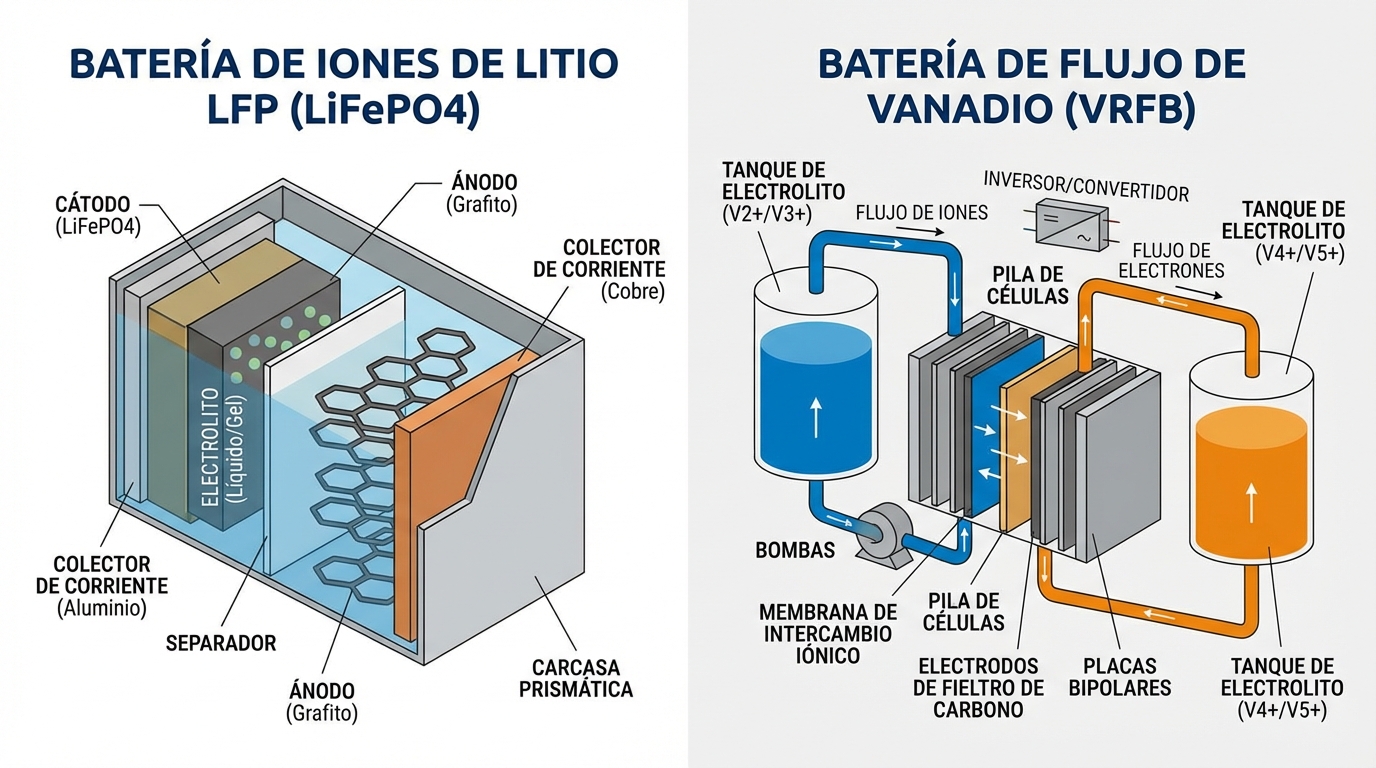
But which battery technology to choose? Li-ion NMC, LFP (lithium-iron-phosphate), or emerging flow batteries (redox flow batteries)? Each has advantages and disadvantages depending on your specific application: price arbitrage, curtailment capture, grid services, or self-consumption backup.
In this article, we’ll break down available storage technologies in 2026, compare CAPEX/OPEX, analyze optimal use cases, and present real cases of hybridized plants in Spain.
1. Taxonomy of storage technologies
Classification by chemistry
| Technology | 2026 Status | Market Share | Main Application |
|---|---|---|---|
| Li-ion NMC (Nickel-Manganese-Cobalt) | Mature | 40% | Utility-scale, high energy density |
| Li-ion LFP (Lithium-Iron-Phosphate) | Dominant | 55% | Utility-scale, long cycles |
| Flow Batteries (Vanadium Redox) | Emerging | 3% | Applications > 4h discharge |
| Na-ion (Sodium-ion) | Commercial pilot | < 1% | Low temperature, low cost |
| Solid-state | Laboratory | 0% | Post-2030 |
Clear trend: LFP has displaced NMC in solar plants for its higher safety and cycle life.
2. Li-ion LFP: The current standard
Technical characteristics
| Parameter | Value (2026) |
|---|---|
| Energy density | 150 - 180 Wh/kg |
| Cycle life (80% DoD) | 6,000 - 8,000 cycles |
| Round-trip efficiency | 88 - 92% |
| Annual degradation | 1.5 - 2.5% capacity/year |
| Useful life | 12 - 15 years (intensive use) |
| Operating temperature | -10°C to +55°C |
| Thermal risk | Very low (doesn’t suffer thermal runaway like NMC) |
Advantages
- Safety: Doesn’t contain cobalt (less fire risk)
- Long cycles: 6,000-8,000 cycles @ 80% DoD (vs 3,000-5,000 of NMC)
- Competitive cost: 180-220 €/kWh (complete system with BMS, PCS, container)
- Availability: CATL, BYD, EVE produce at large scale
Disadvantages
- Lower energy density: 20-30% less than NMC (more space needed)
- Cold performance: Loses efficiency < 0°C
- Calendar degradation: 1.5-2.5%/year even without cycling
Optimal use cases
- Price arbitrage (1-2 cycles/day)
- Curtailment capture (opportunistic discharge)
- Regulation services (aFRR, response < 1s)
- Plants 10-100 MW (economies of scale in containers)
3. Flow Batteries: The long-duration future
What are Flow Batteries?
Unlike Li-ion (where energy and power are coupled in cells), flow batteries separate energy (liquid electrolyte in tanks) and power (electrochemical stack).
Key advantage
Independent scalability:
- Want more power (MW) → add more stacks
- Want more energy (MWh) → add more electrolyte tanks
Vanadium Redox Technology (VRFB)
| Parameter | Value (2026) |
|---|---|
| Energy density | 20 - 35 Wh/kg (very low vs Li-ion) |
| Cycle life | 15,000 - 20,000 (unlimited if replacing electrolyte) |
| Round-trip efficiency | 70 - 80% (lower than Li-ion) |
| Degradation | < 0.5%/year (almost none) |
| Useful life | 20 - 25 years |
| Optimal discharge duration | 4 - 10 hours |
Advantages
- Minimal degradation: Doesn’t lose capacity with cycles
- Absolute safety: Aqueous electrolyte (non-flammable)
- Extended lifespan: 20-25 years (vs 12-15 Li-ion)
- Scalability: Easy to add capacity (only tanks)
Disadvantages
- High CAPEX: 300-450 €/kWh (60-100% more expensive than LFP)
- Low energy density: Takes 3-5x more space than Li-ion
- Lower efficiency: 70-80% vs 90% LFP (lose more energy)
- Complexity: Requires pumping systems, electrolyte temperature control
Optimal use cases
- Seasonal storage (charge in spring, discharge in winter)
- Arbitrage with > 4h discharge (charge at night, discharge late afternoon-night)
- Critical systems (hospitals, datacenters) where lifespan > 20 years is key
- Projects with abundant space (no footprint limitation)
Why haven’t they taken off?
In 2026, flow batteries remain niche (3% market) because:
- Li-ion price has dropped faster than expected (300 €/kWh in 2020 → 200 €/kWh in 2026)
- Most solar applications need 1-4h discharge (Li-ion sufficient)
- 2x CAPEX of flow batteries not compensated by extended lifespan (due to money time discount)
Projection: Flow batteries will gain market post-2028 if Li-ion stagnates at 180-200 €/kWh.
4. Economic comparison: CAPEX and OPEX
CAPEX per kWh (complete system, 2026)
| Technology | CAPEX (€/kWh) | Breakdown |
|---|---|---|
| LFP (2 MW / 4 MWh container) | 200 | Cells: 110 / BMS: 30 / PCS: 40 / Container: 20 |
| NMC (2 MW / 3 MWh container) | 240 | Cells: 140 / BMS: 35 / PCS: 45 / Container: 20 |
| Flow Battery (500 kW / 4 MWh) | 380 | Stack: 150 / Electrolyte: 120 / Tanks: 60 / Pumps: 50 |
Note: Prices for purchases > 10 MWh (projects > 5 MW). Small projects pay 20-30% more.
Annual OPEX
| Concept | LFP (€/kWh/year) | Flow Battery (€/kWh/year) |
|---|---|---|
| Preventive maintenance | 5 | 8 |
| Insurance | 3 | 3 |
| Thermal management (HVAC) | 2 | 4 (pumping) |
| Component replacement | 4 (12-15 year lifespan) | 2 (20-25 year lifespan) |
| Total | 14 €/kWh/year | 17 €/kWh/year |
5. Business models: Arbitrage, grid services and curtailment
A. Price arbitrage (Energy Arbitrage)
Concept: Buy/store cheap energy (night, midday solar surplus) and sell expensive (late afternoon-night, demand peaks).
Typical example:
| Hour | Pool Price (€/MWh) | BESS Action |
|---|---|---|
| 03:00 | 25 | Charge from grid |
| 13:00 | 30 | Charge from panels (avoided curtailment) |
| 20:00 | 65 | Discharge to grid |
Annual revenue (10 MWp plant + 2 MW / 4 MWh BESS):
- Cycles/day: 1.5 (conservative)
- Price differential: 30 €/MWh (average)
- Cycled energy: 4 MWh × 1.5 × 365 = 2,190 MWh/year
- Gross revenue: 65,700 €/year
- Battery OPEX costs: 4,000 kWh × 14 €/kWh = 56,000 €/year
- Net revenue: 9,700 €/year (low, doesn’t justify investment with arbitrage alone)
Conclusion: In Spain (2026), pure arbitrage is NOT viable with current market prices (volatility has decreased vs 2022-2023).
B. Grid services (aFRR, mFRR)
aFRR (automatic Frequency Restoration Reserve): Automatic response to frequency deviations (< 1 second).
Revenue:
- Contracted capacity: 50-150 €/MW/day (according to monthly auction)
- Dispatched energy: 40-80 €/MWh (activations)
Example (2 MW BESS):
- Capacity contracted 50% of time: 100 €/MW/day × 2 MW × 182 days = 36,400 €/year
- Activations (50 MWh/year): 50 MWh × 60 €/MWh = 3,000 €/year
- Total: ~40,000 €/year
Requirements:
- Response time < 1s (Li-ion complies, flow batteries NO)
- Availability > 95%
- REE certification (6-12 month process)
C. Curtailment capture
Problem: In saturated zones (Extremadura, CLM), REE orders production reduction at solar peaks (midday).
BESS Solution: Store energy that would be curtailed and sell later.
Example (plant with 7% annual curtailment):
- Gross production: 17,500 MWh/year
- Curtailment without BESS: 1,225 MWh lost
- BESS captures 80%: 980 MWh stored
- Sold @ 40 €/MWh: 39,200 €/year
This IS a solid business case (8-10 year BESS payback).
Optimal combination: Revenue stacking
Winning strategy: Combine all 3 models
| Source | Annual Revenue (2 MW / 4 MWh BESS) |
|---|---|
| Opportunistic arbitrage | 10,000 € |
| aFRR services | 40,000 € |
| Curtailment capture | 39,000 € |
| Total | 89,000 €/year |
BESS CAPEX: 4 MWh × 200 €/kWh = 800,000 € Annual OPEX: 56,000 € Simple payback: 800,000 / (89,000 - 56,000) = 24 years (without degradation)
With degradation (2%/year):
- Year 1: 89,000 €
- Year 5: 81,000 €
- Year 10: 71,000 €
- Real payback: Doesn’t recover investment in useful life ❌
Hard conclusion: In 2026, BESS is only viable if:
- Curtailment > 8%/year (capture justifies investment)
- You receive subsidies (30-40% CAPEX)
- You expect price drop to < 150 €/kWh (post-2027)
6. Battery degradation and replacement
LFP degradation curve
Factors accelerating degradation:
| Factor | Impact on Degradation |
|---|---|
| High DoD (> 90%) | +30-50% degradation |
| Temperature > 35°C | +20-30% degradation |
| Fast cycles (C-rate > 1) | +15-25% degradation |
| Storage at 100% SoC | +10-15% degradation |
Mitigation strategy:
- Operate between 20-80% SoC (60% DoD) → extends life from 6,000 to 9,000 cycles
- Active HVAC (maintain < 30°C) → reduces degradation 20%
- Avoid cycles > 1C (charge/discharge in > 1 hour) → reduces stress
Degradation model
Example (LFP with 1.5 cycles/day):
- Cyclic degradation: 6,000 cycles × 1.5/day / 365 = 10.95 years to lose 20%
- Calendar degradation: 2%/year × 10.95 years = 21.9%
- Capacity @ year 11: ~60% (end of useful life)
Replacement cost: 110 €/kWh (cells only, without BMS/PCS) → 440,000 € for 4 MWh
Strategy: Most investors don’t replace (sell used battery for second life: electric vehicles, residential self-consumption).
7. Real hybridization cases in Spain
Case A: 50 MW plant + 10 MW / 20 MWh BESS (Badajoz, 2024)
Developer: Ignis Energia BESS Technology: LFP (CATL) Motivation: Chronic curtailment (9%/year)
Year 1 results (2025):
- Avoided curtailment: 4,500 MWh (50% of total, BESS capacity limitation)
- Curtailment revenue: 4,500 × 38 €/MWh = 171,000 €
- aFRR revenue: 85,000 €
- Total revenue: 256,000 €/year
- BESS CAPEX: 4.2 M€
- Payback: 16.4 years (marginal)
Lesson: Only viable because received 1.2 M€ subsidy (30% CAPEX) → Real payback: 11.8 years.
Case B: 20 MW plant + 4 MW / 8 MWh BESS (Ciudad Real, 2025)
Developer: Contact us for this data BESS Technology: LFP (BYD) Motivation: Designed from scratch to maximize revenue (not retrofit)
Strategy:
- DC/AC ratio: 1.35 (27 MWp DC / 20 MW AC) → capture clipping with BESS
- aFRR participation 80% of time
Year 1 results (2026):
- Captured clipping: 1,200 MWh
- Arbitrage: 400 MWh
- aFRR revenue: 180,000 €/year
- Total revenue: ~260,000 €/year
- BESS CAPEX: 1.7 M€
- Payback: 10.5 years (acceptable with subsidy)
Lesson: Designing plant from scratch with BESS allows optimizing DC/AC ratio and capturing more value.
Case C: 2 MW self-consumption + 500 kW / 1 MWh BESS (Madrid, industrial)
Client: Electronics component factory BESS Technology: LFP (EVE) Motivation: Reduce peak consumption (3.0TD tariff penalizes contracted power)
Results:
- Contracted power reduction: -25% (from 2.5 MW to 1.9 MW)
- Power term savings: 80,000 €/year
- Increased self-consumption: +15% (from 70% to 85%)
- Payback: 3.8 years (excellent)
Lesson: Industrial self-consumption with peak management is the best use case for BESS in Spain (2026).
8. Regulation and permits for BESS
Additional procedures
If adding BESS to existing plant:
| Procedure | Duration | Cost |
|---|---|---|
| Substantial AAU modification (Single Administrative Authorization) | 6-12 months | 15,000 - 30,000 € |
| Connection point update | 3-6 months | 5,000 - 15,000 € |
| BESS compatibility certificate (Grid Code compliance) | 2-4 months | 10,000 - 20,000 € |
| Industrial inspection | 1 month | 3,000 - 5,000 € |
Total: 8-16 months, 33,000 - 70,000 €
Regulatory limitations
Problem: In Spain (2026), no compensation mechanism for technical restrictions (curtailment) exists.
Implication: If REE orders curtailment, you don’t receive compensation. BESS allows you to capture that energy, but business case depends on selling it later (not direct compensation).
Comparison with other countries:
- Germany: Compensates 95% spot price for curtailment
- Italy: Compensates 100% in congestion zones
- Spain: 0% (you must assume cost)
Projection: Sector lobby seeks to introduce compensation in 2027-2028 (would improve BESS business case).
9. Main manufacturers and suppliers
Integrated BESS (Turnkey)
| Manufacturer | Technology | Typical Size | Spain Reference |
|---|---|---|---|
| CATL | LFP | 1-100 MW | 15+ projects |
| BYD | LFP | 0.5-50 MW | 20+ projects |
| Sungrow | LFP | 1-50 MW | 10+ projects |
| Tesla (Megapack) | LFP/NMC | 2-100 MW | 3 projects (expensive) |
| Fluence | LFP (partnerships) | 10-200 MW | 5+ projects |
Flow Battery suppliers
| Manufacturer | Technology | Status |
|---|---|---|
| ESS Inc. | Iron flow | Commercial USA, pilot Spain |
| Invinity | Vanadium Redox | Pilot UK/Australia |
| Sumitomo | Vanadium Redox | Commercial Japan |
Availability in Spain: Limited (only pilot projects < 5 MWh).
10. Conclusion: BESS in Spain 2026 - Is it worth it?
Short answer: It depends.
BESS is worth it if:
- Curtailment > 8%/year (lost energy capture justifies investment)
- You receive subsidy (30-40% CAPEX from hybridization programs)
- Industrial self-consumption with high demand peaks (contracted power management)
- aFRR participation (grid service revenue)
- You expect price drop to < 150 €/kWh (post-2027) and can wait
BESS is NOT worth it if:
- Plant without curtailment (< 2%/year) and no subsidy
- Price arbitrage only (insufficient volatility in 2026)
- Small project (< 5 MW) where economies of scale don’t apply
- Expensive financing (if debt > 6%, payback extends > 15 years)
Recommended technology:
- Utility-scale (1-4h discharge): LFP (BYD, CATL)
- Long duration (> 4h): Wait for flow batteries post-2027 (still expensive)
- Industrial self-consumption: LFP (EVE, Sungrow)
Projection 2026-2030:
- LFP price will drop to 120-150 €/kWh → payback < 8 years
- Flow batteries will reach 250-300 €/kWh → compete in > 6h discharge
- Spanish regulation will introduce curtailment compensation → improve business case 30%
Final recommendation: If you have curtailment > 8% and can access subsidies, install BESS now. If not, wait 18-24 months (prices will continue dropping).
Need to simulate BESS business case for your plant? 👉 Use our BESS viability calculator
Want to compare BESS supplier offers? Contact us to connect with certified integrators